A pattern lock can be as secure as a PIN, if you make it long enough and choose it well. On DotSafe's 5×5 grid, there are 74,072 possible patterns of 6 dots, and 1,110,000 of 8 dots, which is more than a 6-digit PIN. The weak points of a pattern are the shapes that people choose and how easy it is to see one drawn. A long password is stronger than both, but harder to use every day.
Many people feel that a pattern is less serious than a PIN or a password. A pattern looks like a game, and the most familiar one, the Android 3×3 grid, is small. But the strength of any secret comes from two things: how many choices there are, and how well a person chooses from them. A short PIN like 1234 is weak, and a long, unusual pattern is strong. The method matters less than the way you use it. So how does a pattern compare with a PIN and a password, and what makes one strong?
This guide first compares the numbers, then explains the two risks that numbers do not show: human habits and people who watch. It ends with what protects a pattern in DotSafe, and how to choose a good one.
On a 5×5 grid, a long pattern has more choices than a 6-digit PIN
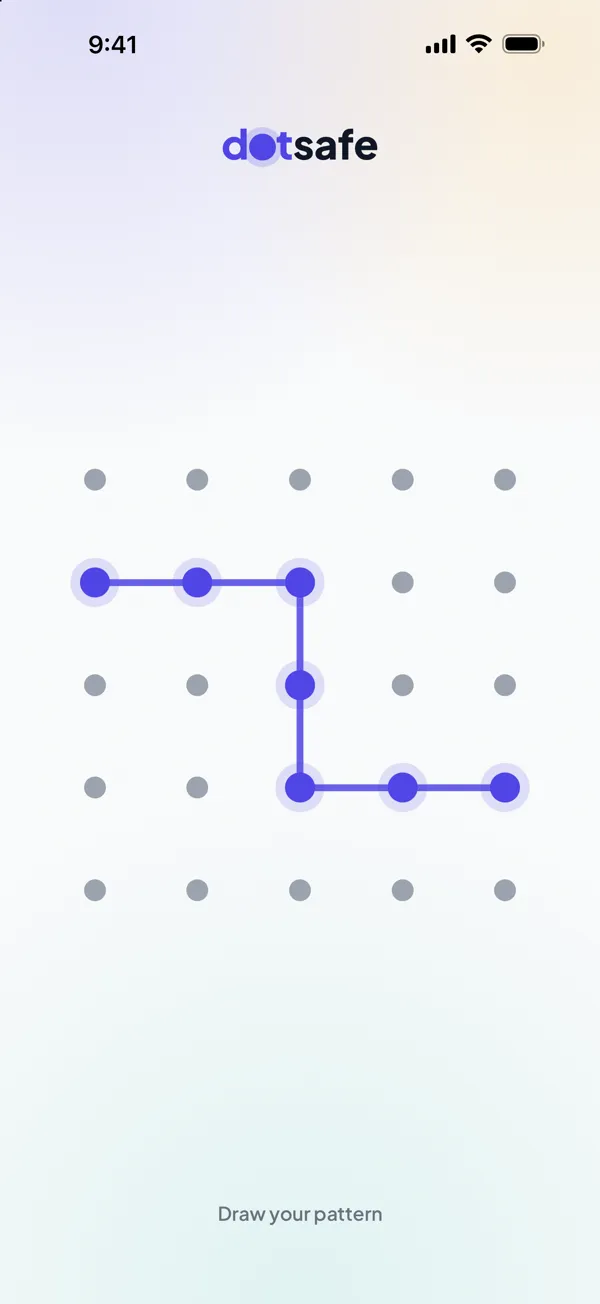
A pattern on DotSafe's grid follows simple rules. It has at least 4 dots. Each dot must be next to the one before it: across, up, down or diagonal. And you can use each dot only once. We counted every pattern that these rules allow:
| Length | Pattern | PIN | Password |
|---|---|---|---|
| 4 dots or digits | 3,768 | 10,000 | Not used |
| 6 dots or digits | 74,072 | 1,000,000 | Not used |
| 8 dots, digits or characters | 1,110,000 | 100,000,000 | 218 trillionLetters and digits |
| 10 dots or digits | 12,956,800 | 10,000,000,000 | Not used |
Dot for dot, a PIN has more choices, because any digit can follow any other. A pattern has fewer, because each dot must touch the last one. But a pattern is one movement of the finger, so a longer one is still quick to draw. An 8-dot pattern has about as many choices as a 6-digit PIN. Each extra dot multiplies the number by between three and four.
A password with letters and digits is in a different class. Even 8 random characters give hundreds of trillions of choices. The cost is that you must type it each time.
Human habits make every method weaker than its numbers
The numbers above assume that each choice is equally likely. People do not choose like that. They choose dates and repeated digits for a PIN, and simple shapes for a pattern: a letter, a square, a line along the edge, a start in the top-left corner. A person who wants to guess starts with these, and so the real strength is lower than the number.
This affects patterns and PINs in the same way. The answer is the same too: choose something that does not mean anything, and make it longer than the minimum.
A pattern is easier to see than a PIN
The second risk is a person who watches. A pattern is a shape, and a shape is easy to remember after one look across a table. A PIN is a series of separate taps on small keys. A finger also leaves a smear on the screen, and on a clean screen the path of a pattern can show in the right light.
There are simple defences:
- Turn off the trail, so the grid shows no lines while you draw. In DotSafe, turn off Show pattern trail in Settings, under Privacy.
- Draw where no one can see the screen.
- Choose a pattern with many turns, which is harder to follow than a smooth shape.
- Wipe the screen now and then.
What protects a pattern in DotSafe
A lock is only as strong as what happens after you draw it. Your iPhone passcode is protected by the device: iOS adds a delay after wrong attempts. DotSafe uses a different design, for a different reason.
DotSafe never counts attempts and never shows a wrong pattern. Every pattern opens a vault, and an unknown pattern opens a new, empty one. This is what lets you open a decoy vault when someone makes you open the app. It also means that DotSafe cannot lock out a person who guesses. So DotSafe makes each guess slow instead:
- DotSafe turns your pattern into a key with 600,000 rounds of PBKDF2-HMAC-SHA256. Each pattern takes a noticeable moment to open, for you and for anyone who tries to guess.
- The calculation also uses a random 32-byte salt. DotSafe keeps the salt in your iCloud Keychain. Without it, a copy of DotSafe's storage alone is not enough to test patterns.
- DotSafe does not store the pattern. It erases the pattern, and the key that it makes from the pattern, from memory straight after use.
Because DotSafe has no lockout, the length of your pattern matters more than in an app that does. Use 6 dots or more, and 8 or more for your most private vault. How to choose a strong pattern gives practical tips.
Choose the method that you will use well
A long password is the strongest in theory. But a secret that you must enter many times a day has to be one that you can enter quickly and in private. A pattern of 8 dots, with many turns and no letter shapes, drawn where no one can see, is a strong lock. A 4-digit PIN that is a birthday is not, whatever the method.
Questions
Is a pattern lock more secure than a PIN?
It depends on the length. A PIN has more choices for each digit. On a 5×5 grid, an 8-dot pattern has about as many choices as a 6-digit PIN. The way you choose matters more than the method.
How many possible patterns are there on a 5×5 grid?
With DotSafe's rules, there are 3,768 patterns of 4 dots, 74,072 of 6 dots, 1,110,000 of 8 dots and 12,956,800 of 10 dots.
Can someone guess my pattern by watching me?
Yes, if they see the screen. A shape is easy to remember. Turn off the pattern trail, draw where no one can watch, and use a pattern with many turns.
Why does DotSafe not lock after wrong patterns?
Because DotSafe has no wrong pattern. Every pattern opens a vault, so nobody can tell which vaults exist. DotSafe makes each attempt slow instead, with 600,000 rounds of PBKDF2.