Encryption protects your data from a person who does not have the key. It does not help when someone makes you open the app, because you have the key. Plausible deniability is protection for that case.
The problem with a locked app
Many vault apps show a PIN screen. If the PIN is wrong, they show an error. This tells anyone who watches that something is in the app. If someone makes you open it, you must open everything, or refuse.
Plausible deniability means that you can open the app, show something believable, and no one can prove that there is more.
How DotSafe does it
Every pattern opens a vault
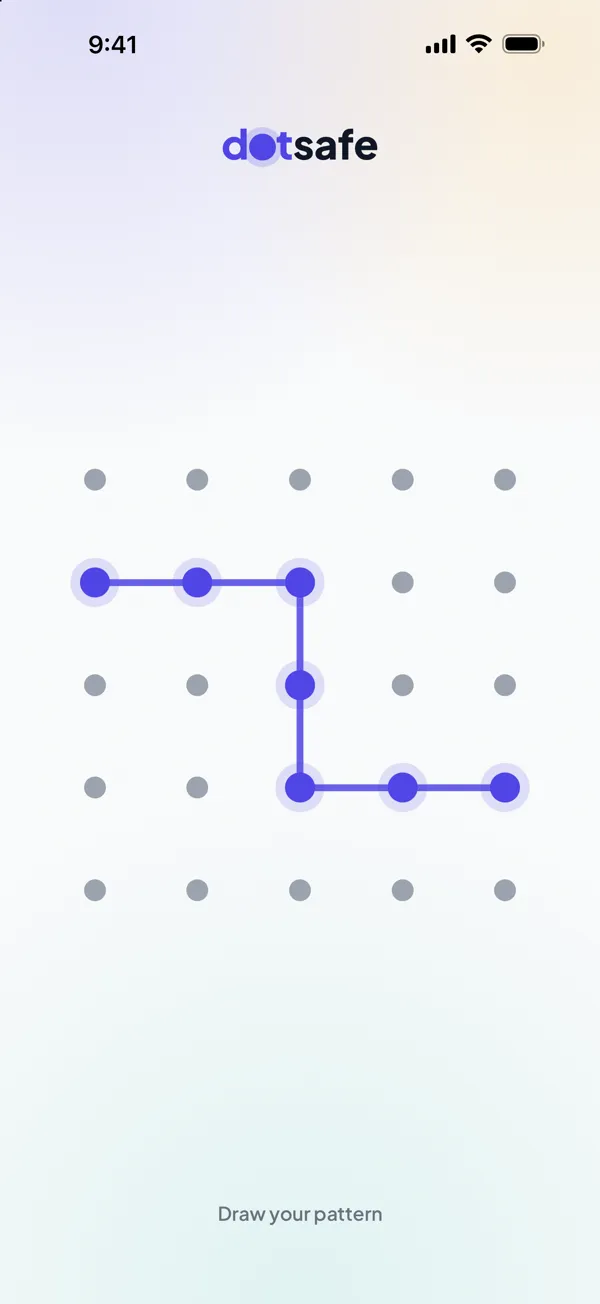
DotSafe has no wrong pattern. A pattern that you used before opens its vault. A new pattern opens a new empty vault. The two cases look the same. DotSafe does not count attempts, does not add delays and does not lock you out.
Thus, if you open a vault and say "this is all I have", the app gives no sign that other vaults exist.
No list of vaults
DotSafe has no screen that lists your vaults, and it keeps no list anywhere. The app itself cannot find a vault without its pattern. Settings shows the size of the open vault only, not the total size of all vaults.
Storage that does not show the number of vaults
A person with forensic tools can copy the storage of a device. In DotSafe, that copy shows a folder of blocks with the same size and random names. It also shows a set of index files, many of which are cover files with random data. Real index files and cover files look the same. The number of cover files starts at a random value. Thus the count of files does not show how many vaults there are. How DotSafe encrypts your files explains this in more detail.
The duress pattern
If you set a duress pattern and draw it, DotSafe erases every vault on the device and then opens an empty vault, with no sign of the erase. Read The duress pattern before you set one.
How to use it well
- Keep a decoy vault that looks used. An empty vault is not believable. Setting up a decoy vault has tips.
- Do not tell people how many vaults you have. The app cannot give it away, but you can.
- Do not share a vault that you want to deny. The people in a shared vault know that it exists.
- Turn on Hide in app switcher. It is on by default. It stops the app switcher from showing the last vault that you had open.
Where it stops
Plausible deniability makes it impossible to prove that more vaults exist. It does not make it impossible to suspect it. Some limits are good to know:
- The app is visible. A person can see that DotSafe is on your device. Everyone who uses DotSafe can have a decoy vault, so its presence proves nothing about what is in it.
- Two copies at different times show change. If someone copies your storage today and again next week, they can see that data changed. DotSafe writes cover data at each save to make this less useful. It cannot hide that you used the app.
- The Free vault limit can show one fact. On Free, after 3 vaults, a new pattern opens a vault that cannot save. A person who holds your unlocked device and tries this can learn that you are at the limit. On Pro there is no limit, so this does not apply.
- iCloud shows how many vaults you share. It does not show what is in them, or the vaults that you do not share.
- People can watch. If someone saw you draw a pattern, they know that pattern.
No app can protect you in every situation. If you are in danger, your safety is more important than your data.