The App Store has hundreds of photo vault apps. Almost all of them say that they are secure. These eight questions show what an app really does. You can answer most of them from the App Store page and the developer's website in a few minutes.
1. Does it need an account?
If a vault app asks for an email address or a sign-in, the developer has a server that knows who you are. That can be fine for a cloud service, but it is one more place where your data, or the fact that you use a vault, can leak.
Look for: an app that works with no account at all.
2. Where are the keys?
Encryption is only as private as the key. If the developer can reset your PIN or recover your vault by email, the developer can get to the key, or the app does not really encrypt your data with it.
Look for: a clear statement that the key comes from something only you know, and that the developer cannot recover it. A "forgot PIN" email reset is a warning sign.
3. Is the data encrypted, or only hidden?
Some vault apps copy photos into their own folder and show a PIN screen in front of them. The files themselves are not encrypted. A person with a computer and a backup of the device can read them.
Look for: a named method, for example AES-256-GCM, applied on the device to each file. "Military-grade" and "bank-level" are marketing words, not methods.
4. What happens with a wrong PIN?
An app that shows "wrong PIN" proves that there is something to open. An app that takes a photo of the person or locks you out does the same, and makes it clear that you have a vault.
Look for: if someone could make you open the app, an app that can show a decoy. In the best designs, every PIN or pattern opens something, so no attempt looks wrong. Plausible deniability, explained describes the idea.
5. What does the App Store privacy label say?
Every App Store page has an "App Privacy" section. It lists the data that the app collects and whether it is used to track you.
Look for: "Data Not Collected". A vault app with advertising SDKs or "Data Used to Track You" sends information about you to other companies.
6. Are there ads?
Ads in a vault app mean advertising code from another company, inside the app that holds your private photos. Free apps with ads also have a reason to collect data.
Look for: no ads. A free plan with limits and a paid plan is a more honest model.
7. Is the backup encrypted before it leaves the device?
Cloud backup is useful. But if the app uploads your photos to its own servers, or uploads them to iCloud without its own encryption, your privacy depends on the security of that service.
Look for: backup that is encrypted on your device first, to a service that cannot read it.
8. Does the developer say what the app cannot do?
Every security design has limits. A developer who lists them, for example "a forgotten PIN cannot be recovered", understands the design. A developer who promises "100% secure" does not, or hopes that you do not.
Look for: a page about the threat model and the limits, not only the features.
How DotSafe answers these questions
We built DotSafe to give good answers to all eight:
- No account and no email.
- The key comes from your pattern. We cannot recover it.
- Each item is encrypted on the device with AES-256-GCM and its own key.
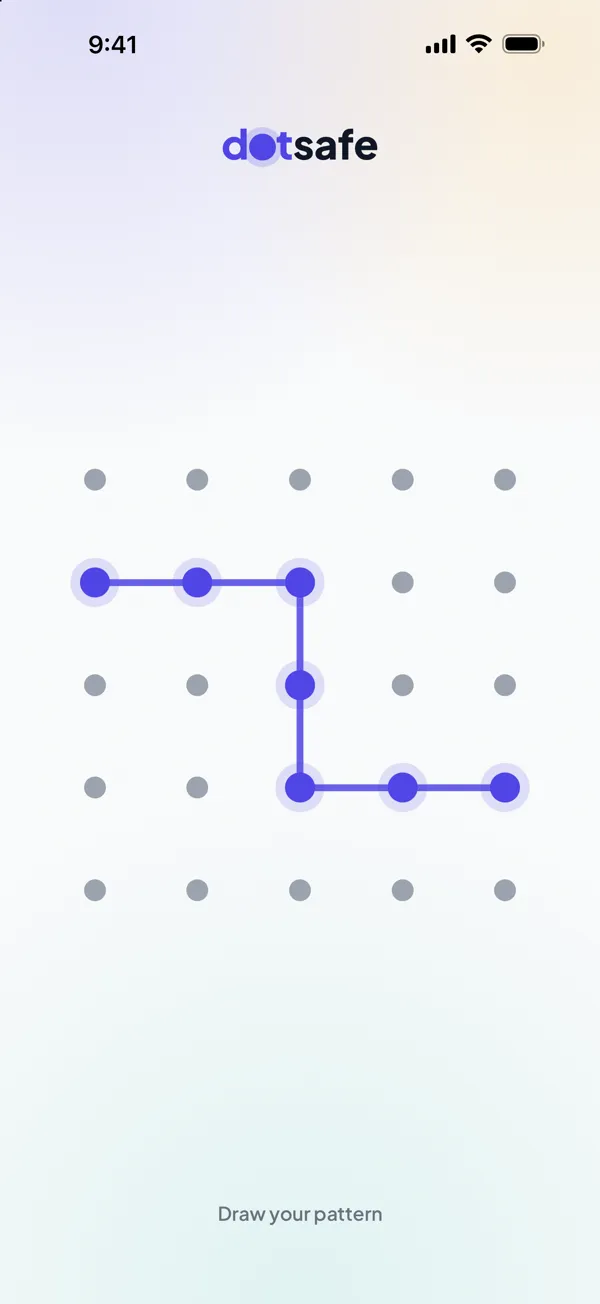
- Every pattern opens a vault. There is no wrong pattern and no lockout.
- The app collects no data.
- No ads.
- With Pro, the iCloud copy is encrypted on your device first.
- The security page lists what DotSafe cannot do.
Do not trust this list because we wrote it. Check the App Store page and the encryption details, and ask the same questions of any app that you consider.